What Is an Open Mic Night?
19 June 2026
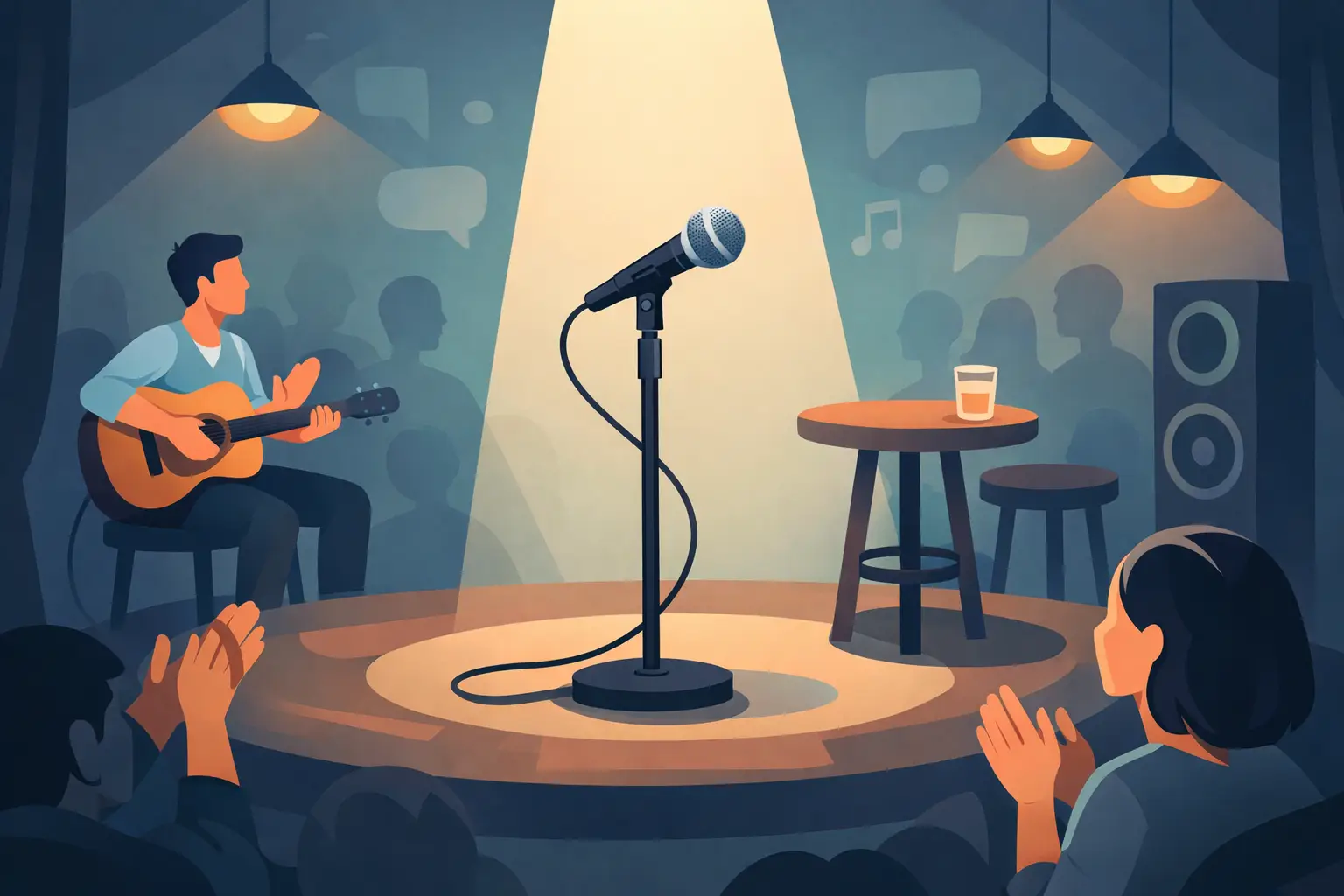
You can learn a lot about a local music scene from its open mics. If the room is warm, the host is organised, and the crowd actually listens, chances are you have found a place where artists grow. So what is an open mic night, really? At its simplest, it is a live event where performers sign up for a short slot and play in front of an audience. In practice, it is also a low-pressure way to test songs, meet people, build confidence, and become part of a scene.
For musicians, singers, songwriters, poets and spoken-word artists, open mics often sit right at the entry point of local participation. They are more accessible than full gigs, less formal than showcases, and usually more welcoming than people expect. If you are new to performing, they can be your first real audience. If you already play live, they can still be useful for trying fresh material, meeting collaborators, or staying visible between bigger shows.
What is an open mic night and how does it work?
An open mic is an event where anyone can put their name down to perform, usually for a short set. Most sessions are hosted by a venue, promoter, community organiser or working musician. The format can vary, but the basic structure stays familiar: performers arrive, sign up, wait for their turn, and play one or more songs or pieces.
Some open mics work on a first come, first served basis. Others have online sign-ups in advance. Some are acoustic-only, while others provide a full PA, microphones, house instruments or even a backing band. In some cities, the phrase can overlap with jam nights, but they are not exactly the same thing. An open mic usually centres on individual performance slots. A jam session is more fluid and collaborative, with musicians joining in together.
The set length matters. At one venue you might get two songs and a strict ten-minute slot. Somewhere else you may get fifteen minutes if the night is quieter. That short format is part of the appeal. It keeps the event moving and gives a lot of artists a chance to perform.
Why open mic nights matter in local scenes
Open mics do more than fill a midweek slot in a pub or café. They create a place for local talent to be seen and heard without needing a booking agent, a big following or a polished press pack. That matters because most music scenes are still fragmented. Opportunities are often spread across group chats, social posts, venue noticeboards and word of mouth. Open mics cut through some of that by giving people a physical space to show up, connect and be remembered.
They are also one of the few places where early-stage artists and seasoned players share the same room. A first-time singer might perform right before a gigging guitarist who has been on the circuit for years. That mix is good for scenes. It makes them less closed off and more dynamic.
For hosts and promoters, open mics can double as a talent-spotting tool. For musicians, they can lead to dep spots, collaborations, support slots and introductions that would not happen online alone. A strong local reputation often starts with simply being present and performing well in smaller rooms.
Who are open mics for?
The short answer is almost anyone with something to perform. Musicians are the obvious fit, but open mic sessions often welcome comedians, poets, spoken-word artists and storytellers too. Some nights are genre-specific, while others are intentionally broad.
If you are a singer-songwriter, an open mic is an easy way to road-test original material. If you are a covers performer, it can help you sharpen stage presence and crowd reading. If you are an instrumentalist, it is a chance to meet vocalists, bands and other players. Even producers and music directors sometimes attend to see who is active locally.
That said, not every open mic suits every artist. A stripped-back acoustic night may not be ideal for someone whose set depends on tracks, loops or heavy production. A noisy bar crowd may frustrate performers who want close listening. It depends on your goals. If you want exposure, almost any room has value. If you want the right audience, you may need to be more selective.
What to expect when you go to one
If it is your first time, expect a mix of nerves and friendliness. Most open mic rooms have a recognisable rhythm. People arrive early to grab a decent slot. The host checks names and explains the setup. There is usually a quick soundcheck or at least a microphone check, then the performances begin.
The audience can be equally mixed. Some people are there specifically to listen. Others are friends of performers, venue regulars, or musicians waiting for their turn. That means the energy in the room can shift a lot from night to night. One session may feel intimate and attentive. Another may be buzzy and social.
You should also expect practical limits. House gear may be basic. Start times can drift. Not every host runs a tight ship. That does not automatically make the night bad, but it is worth being realistic. Open mics are often grassroots events, and the best ones succeed because the community helps carry them.
Why musicians use open mics strategically
A lot of people think open mics are only for beginners. That is not really true. Plenty of experienced artists use them with purpose. They are a useful place to test a new arrangement, trial audience reaction to an unreleased song, or get comfortable with material before a paid gig.
They can also help with visibility. If you play consistently in the same city, people start to recognise your name, face and sound. That familiarity matters. Local scenes often run on trust as much as talent. When promoters, hosts and fellow musicians know you can turn up prepared and deliver in the room, more opportunities tend to follow.
This is where having your activity and experience visible in one place can make a real difference. Platforms built around local discovery and artist credibility, such as Groovehub, make it easier for musicians to find open mics and also show what they bring to the scene when they do.
How to make the most of an open mic session
The smartest approach is simple: treat it seriously without treating it like an audition for your entire future. Turn up on time, know your material, and bring only the gear you actually need. If the host says one song, do one song. If the room is acoustic, do not arrive with a setup that takes fifteen minutes to build.
Song choice matters too. At an open mic, your first impression often lands fast. One strong, well-rehearsed song usually does more for you than three half-ready ones. Read the room, but do not flatten your identity trying to please everyone. The goal is not to become generic. It is to be memorable for the right reasons.
It is also worth staying after your set. A lot of the value sits in the conversations around the performances rather than the performance alone. Talk to the host. Support other artists. If someone likes what you do, make it easy for them to find you again.
Common misconceptions about open mics
One misconception is that they are always casual and low quality. Some are loose around the edges, yes, but many are run brilliantly and attract serious talent. Another is that you need to be fully polished before you go. In reality, open mics are partly for development. You do not need to be perfect. You do need to be prepared.
Another common misunderstanding is that every open mic is a networking goldmine. Sometimes it clicks, sometimes it does not. The room, host, timing and city all matter. One night may give you a new collaborator. Another may simply give you ten minutes of stage time and a better sense of what needs work. That still counts.
Is an open mic session worth it?
If you want more stage time, stronger local connections and a practical route into live performance, usually yes. The trade-off is that open mics can be inconsistent. Some rooms are excellent, others are forgettable. Some audiences are engaged, others barely look up from their drinks. But even then, there is value in learning to hold a room, adapt on the fly and keep showing up.
That is really the point. Open mics are not just about getting on stage. They are about becoming part of something active and local, where your next collaborator, gig or creative push might start with one short set in the right room. If you are looking for a way in, start there - then keep going.