What a Musician Networking Platform Should Do
26 June 2026
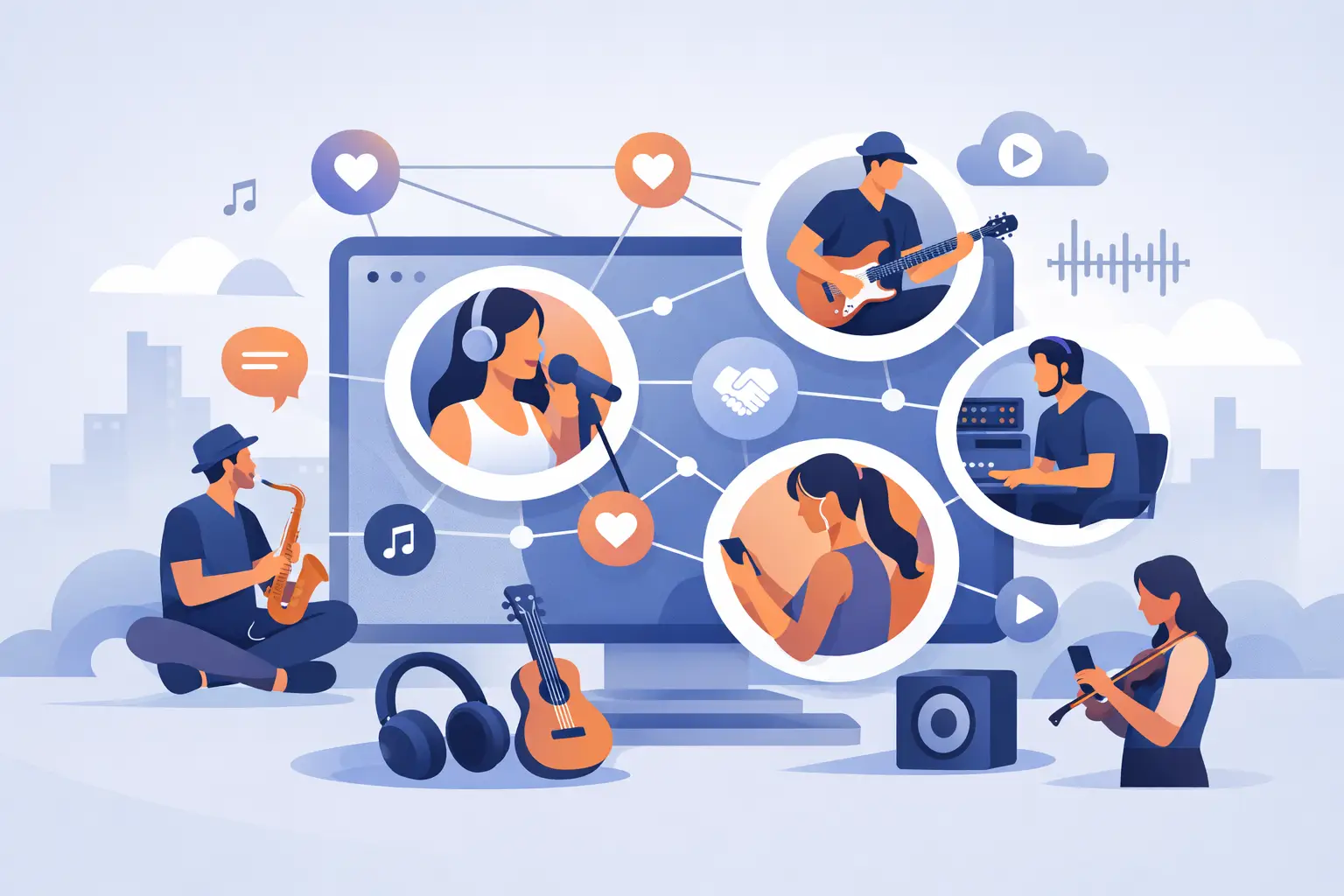
You hear about a great jam night two days after it happened. A promoter asks for examples of your work and references, but your best material is scattered across Instagram, old messages and a half-finished website. You meet solid players at an open mic, promise to stay in touch, then lose the thread by the next week. That is exactly where a musician networking platform should earn its place.
For working artists, local scenes still run on energy, introductions and reputation. That part is not going away, and honestly it should not. Music communities are built by people showing up. The problem is that too much of the practical stuff still lives in disconnected places. Event info sits in one corner, artist credibility in another, and actual collaboration happens somewhere in between. A proper musician networking platform brings those parts together so your next opportunity does not rely on luck alone.
Why a musician networking platform matters locally
Most musicians do not need another place to collect likes. They need a better way to participate in their city. That means knowing what is on, who is active, who is credible, and how to get involved without spending half the week chasing fragmented information.
Local music scenes are full of talent, but they are often hard to navigate from the outside and messy even when you are already inside. Open mics are promoted inconsistently. Jam sessions get shared in private stories. Recommendations travel by word of mouth. If you are new in town, early in your career, or simply trying to expand your circle, the gap between being good and being visible can be frustratingly wide.
A focused platform helps shrink that gap. It gives artists a place to be found in context, not just as a profile picture and a bio line, but as an active participant in a real local ecosystem.
What a good musician networking platform should actually help you do
The first job is discovery. You should be able to find open mics, jam sessions, showcases and other local music events without trawling five different apps and a string of group chats. If event discovery is not easy, people miss chances to play, meet collaborators and stay visible.
The second job is presentation. Musicians need something more useful than a generic social profile. If someone wants to book you, invite you to dep, or bring you into a project, they need a quick read on what you do, what you have done, and whether others trust working with you. That is where a music-focused profile matters. It should show your skills, experience, media, recommendations and direction clearly enough that another musician or organiser can make a decision.
The third job is trust. This is the bit many platforms miss. In real scenes, credibility is social. People ask who you have played with, whether you turn up prepared, what kind of energy you bring, and whether you fit the room. A useful platform should support that layer through recommendations, reviews or visible community signals. Not to turn music into a scorecard, but to help good people get recognised faster.
Discovery is not a small feature - it is the engine
If you want more gigs, more collaborators and more momentum, you need more relevant chances to show up. That sounds obvious, but it is often where things break down. Generic platforms can tell you a lot about global reach and personal branding. They are less helpful when what you really need is a soul jam in Brighton on Thursday or an open mic where original artists actually get listened to.
A city-based approach changes the value completely. It lets musicians work with proximity, which still matters more than people admit. Rehearsals happen in real rooms. Last-minute sub calls need someone nearby. Bands form because people keep crossing paths in the same venues and sessions.
When a platform is built around local scenes, discovery becomes practical. You are not just browsing content. You are spotting places to play, rooms to learn in, and communities you can join this week.
Your profile needs to do more than look nice
A polished profile is useful, but polish alone does not get you booked. People need enough detail to understand whether you are right for the opportunity. Are you a session bassist who reads charts? A songwriter looking for a producer? A vocalist with strong live experience and clips to prove it? The more clearly that picture comes across, the easier it is for the right people to reach out.
This is why a digital artist CV makes sense for music. It gives structure to what is usually chaotic. Instead of sending people through random posts, highlights and voice notes, you can show the essentials in one place. Experience, skills, media and artistic ambition all matter, because booking and collaboration decisions are rarely based on one thing.
That does not mean every musician needs to present themselves like a corporate candidate. Personality still matters. Style still matters. But clarity saves time for everyone.
Music networking works better when credibility is visible
The phrase networking can put some artists off because it sounds transactional. In practice, most musicians are not trying to work a room. They are trying to find people who are serious, reliable and creatively aligned.
That is why visibility without credibility is limited. A profile may get attention, but recommendations and scene-based proof help turn attention into trust. If another artist, organiser or collaborator can see that you have been active, reviewed positively or recommended by people in the scene, the conversation starts from a better place.
There is a balance here. Not every brilliant artist is well documented, and not every newcomer has references ready to go. A good platform should support emerging musicians rather than favouring only those who already have social proof. Still, some form of music-specific credibility layer is valuable because it reflects how local scenes actually work.
Generic social media is useful - but it is not enough
Social platforms are still part of the mix. They help with promotion, audience building and staying visible. But they are not designed around the specific needs of local musician discovery.
The trade-off is simple. Social media gives reach, but not always relevance. You might get plenty of views from people nowhere near your city, while missing the drummer, MD or promoter who would actually change your month. A dedicated musician networking platform is narrower by design, and that is the point. It is meant to help the right people find each other more efficiently.
There is also less pressure to perform a constant content strategy. Many musicians are great on stage and less interested in feeding an algorithm every day. A specialist platform can let your experience, availability and local participation do more of the work.
What this looks like in practice
Say you are new to a city and want to get into the scene fast. You need to know where the regular sessions are, which venues welcome emerging artists, and who is actively gigging nearby. A musician networking platform can shorten that learning curve massively.
Or maybe you are already established but tired of chasing the same scattered information every week. You want one place to check what is on, promote your own event, and keep a credible public profile ready when opportunities come in. That is not a luxury feature. It is basic infrastructure for a healthier local scene.
This is where Groovehub makes sense as a practical example. By combining local event discovery with a professional artist profile built for music, it supports both sides of the equation - being present in the scene and being understood within it.
The best platform is the one people actually use
Features matter, but density matters more. A brilliant tool with no local activity will not help much. For any musician networking platform to be genuinely useful, artists, hosts, promoters and creatives all need reasons to show up regularly.
That is why accessibility matters. If a platform is free to use and easy to join, it lowers friction and helps scenes grow faster. More users means more discovery, more recommendations, more listings and better chances that the person you need is already there.
Community-first design matters too. If the platform feels extractive or gatekept, people drift. If it feels built around participation, local pride and practical value, it has a better chance of becoming part of the scene rather than another app sitting on your phone.
A musician networking platform should not replace the human side of music. It should make it easier to find, support and trust each other in the places where music is already happening. If it helps you show up more often, connect more clearly and build a stronger reputation in your city, that is not just useful tech. That is momentum you can actually build on.