Music Networking Apps Review for Local Artists
5 July 2026
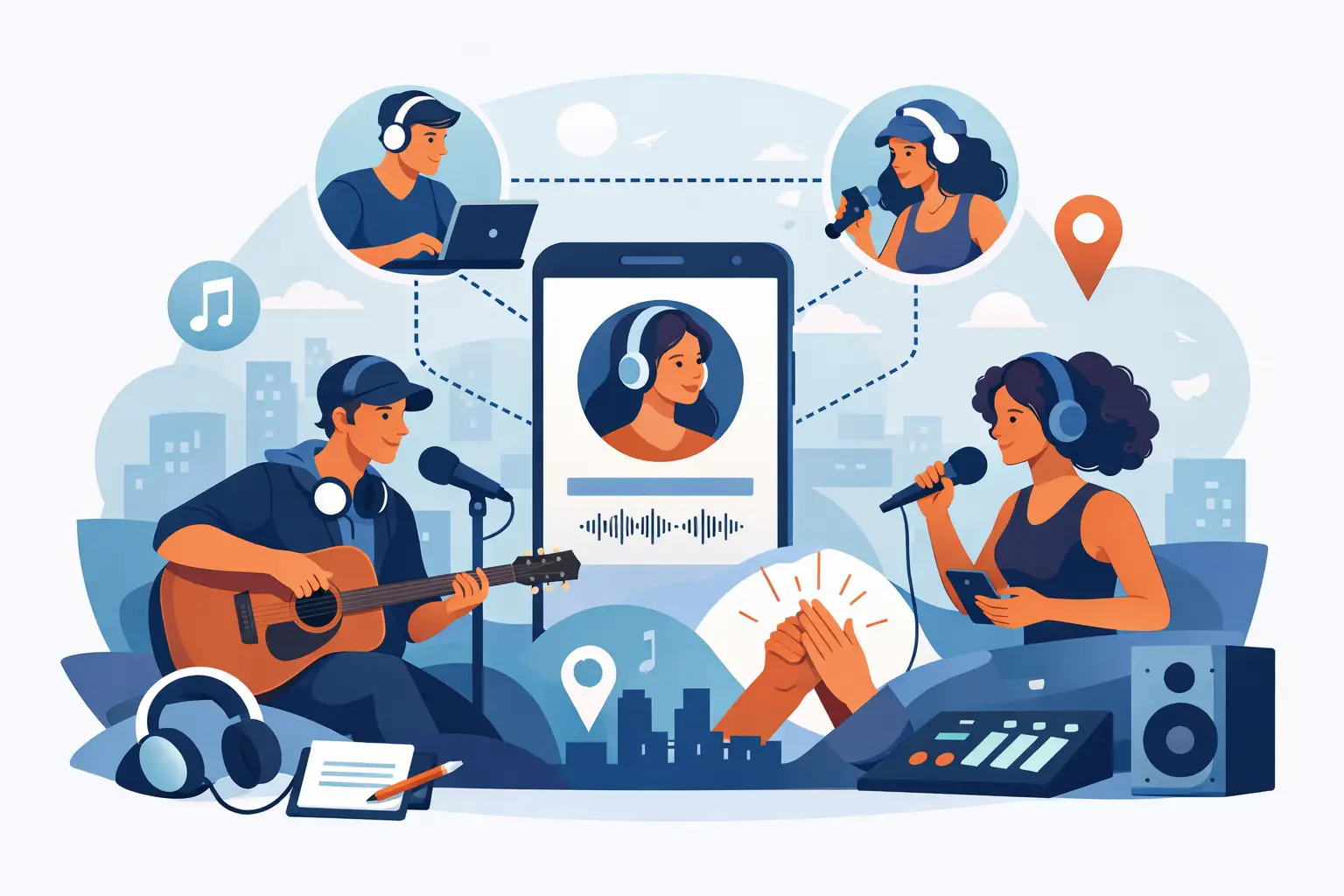
If you have ever found out about a great jam night the morning after it happened, you already know the problem. Local music scenes are full of opportunity, but the information is scattered, the introductions are informal, and proving you are the right person for a project often comes down to who already knows your name. That is exactly why a proper music networking apps review matters.
Most musicians do not need another generic social feed. They need a faster way to find what is on nearby, meet collaborators who actually fit, and show enough credibility that a band leader, promoter or host can say yes without a long back-and-forth. The best apps are not just places to chat. They help artists participate in a real scene.
What a music networking apps review should actually measure
A lot of round-ups judge music apps like consumer social platforms. That misses the point. If you are a gigging singer, drummer, producer or songwriter, the real test is practical. Can the app help you get into rooms, meet reliable people and make your experience visible?
That means four things matter most. First, local discovery. If an app cannot show you nearby open mics, jam sessions, showcases or community events, it is already less useful for scene-building. Second, profile quality. A music network works better when people can quickly understand your skills, style, experience and ambition. Third, trust signals. Reviews, recommendations, past work and mutual connections reduce the risk that comes with booking or collaborating. Fourth, activity. Even a beautifully designed platform is no use if nobody in your city is using it.
This is where trade-offs begin. Some apps are strong on messaging but weak on event discovery. Others are good for promotion but not for musician-to-musician credibility. A few look polished yet feel empty unless you are in a major music city.
The main types of music networking apps
Not every platform is trying to solve the same problem, so comparing them fairly matters.
Social-first music apps
These platforms lean heavily on posting, following and direct messaging. They can help artists stay visible and keep conversations warm, but they often struggle with local relevance. You might meet talented people, yet still have no clear view of what is happening in your city this week.
They suit artists who are good at content and already have some momentum. They are less effective for someone who needs immediate, practical access to open sessions, band opportunities or trusted local introductions.
Collaboration-first apps
These are built around finding bandmates, producers, vocalists or session players. That can be useful if your main goal is assembling a project. The weakness is that collaboration without local context can feel abstract. You may find people who match your genre, but not those who are active in the venues and communities you want to be part of.
For remote work, that may be fine. For local scene participation, it is only half the answer.
Event-first local platforms
This category tends to work best for musicians who want momentum now. If you can quickly find open mics, jam sessions, gigs and community-led events, you can start showing up, meeting people and being seen. That creates the kind of networking that is harder to fake online.
The limitation is that event listings alone do not always tell people why they should work with you. Discovery needs to connect with profile depth and reputation if the platform is going to support real professional growth.
Hybrid platforms with profile credibility
This is the strongest model for active local artists. A platform that combines event discovery with a proper music-focused profile gives users two things at once: somewhere to find opportunities and a way to present themselves professionally. That is a very different experience from dropping an Instagram handle in a group chat and hoping for the best.
For musicians trying to build a name city by city, this hybrid approach usually makes the most sense.
Music networking apps review: what local artists should look for
If you are deciding where to invest your time, start with your actual goal. Not your ideal future plan - your real next step.
If you need gigs or stage time, prioritise event density and local filtering. If you need collaborators, focus on search quality and profile detail. If you are trying to become more bookable, trust signals matter more than follower counts. An app should help someone understand what you do without needing five separate messages and a frantic search through old clips.
The strongest platforms make this easy. You can scan who a person is, what they play, what they have done, and whether others rate working with them. That reduces friction for everyone, especially in local scenes where opportunities move quickly.
You should also pay attention to how the app handles participation. Some networks reward people who are already visible. Others help newer artists get discovered through searchable profiles, recommendations and event activity. If a platform only works once you are already established, it is not much use as a growth tool.
Where many apps still fall short
The biggest gap is fragmentation. One app helps you chat. Another helps you post clips. Another lists events inconsistently. Another lets you create a profile, but gives nobody a reason to visit it. Musicians end up stitching together a working system from too many places.
That is tiring, and it slows everything down. It also makes local scenes harder to navigate, especially if you are new in town, switching genres, or returning after time away.
Another issue is weak professional context. In informal music networks, people still need signals that you are dependable, prepared and right for the room. Generic bios do not do enough here. A proper artist profile should feel closer to a music CV than a casual social account.
Then there is the community problem. Some apps are built like marketplaces, which can make every interaction feel transactional. Local music scenes do not work like that. They run on repeated attendance, recommendation, trust and contribution. The best tools support that culture rather than flattening it.
Why local scene fit matters more than broad reach
It is tempting to choose the platform with the biggest audience, but broad reach is not always the same as useful reach. A thousand passive users spread across the country may be less valuable than a smaller, active cluster in your city.
For most working musicians, the real question is simple. Can this app help me find people and opportunities close enough to act on this week? If yes, it has practical value. If not, it may still be interesting, but it is not solving the urgent part of music networking.
This is why city-based discovery feels so powerful when it works properly. It shortens the distance between finding an opportunity and showing up. It also creates a stronger feedback loop. You meet people at events, they recognise your profile, they see your experience, and the next introduction gets easier.
That kind of momentum is hard to build on general-purpose platforms.
What a stronger model looks like
A more useful music network combines three layers. The first is local discovery, so artists can quickly find open mics, jams and scene activity. The second is a professional identity layer, so users can present skills, experience, media and recommendations in one place. The third is community trust, where reputation grows through participation and visible feedback rather than vanity metrics.
That combination is much closer to how musicians actually build careers. They do not grow through one viral post alone. They grow by being present, meeting the right people, doing good work and making that work legible to others.
This is also where a platform like Groovehub fits naturally into the conversation. By combining local event discovery with a digital artist CV and community-led credibility, it addresses the gap many musicians feel every week: too much noise, not enough structure. That kind of focused design is especially useful for artists who want to build a name in a real city scene rather than chase attention in a generic feed.
How to choose the right app for you
Treat it like choosing rehearsal space or gear. Pick the tool that matches the job.
If you are early in your journey, look for a platform that helps you get into rooms quickly and makes it easy to present yourself well. If you are already gigging, choose one that strengthens your local reputation and helps promoters or collaborators assess fit fast. If you split your time between online collaboration and live work, you may need a mix, but one strong local platform can still be the anchor.
Give any app a fair test. Build your profile properly, upload relevant material, check event activity in your area and use search with intent. If after a few weeks you still cannot see clear local value, the issue may be the platform, not your effort.
The best music networking app is rarely the one with the most noise around it. It is the one that makes your next conversation, your next booking or your next introduction easier. Choose the platform that helps you be visible where you actually play, and the right people will have a much better chance of finding you.