Music Event Calendar Tools That Build Local Scenes
29 July 2026
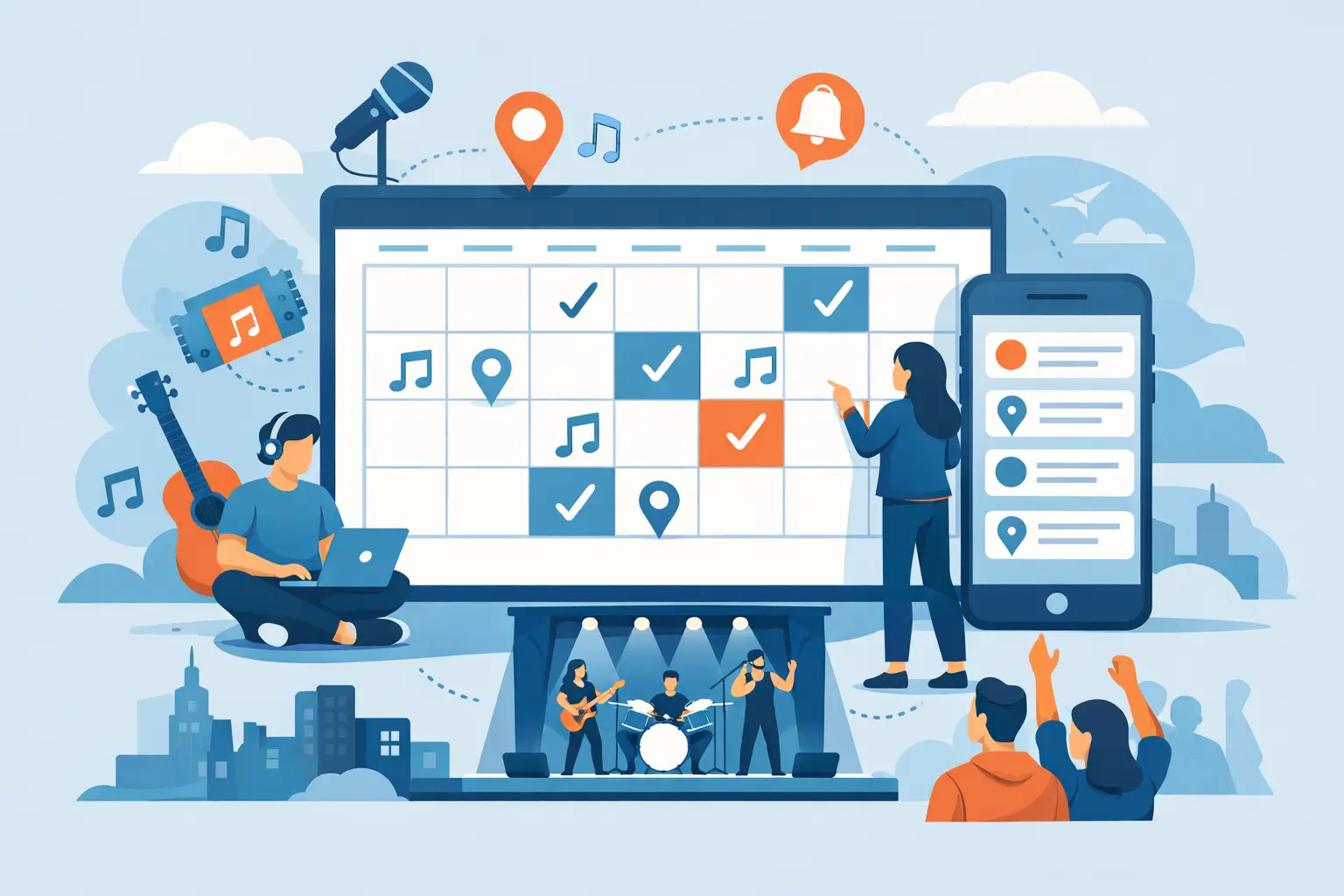
A great night of music can still be invisible at 4pm if the details live in one Instagram Story, a venue website nobody checks and a group chat that has gone quiet. Music event calendar tools exist to fix that gap. They give musicians one reliable place to find what is on, and give hosts a practical way to put open mics, jam sessions, gigs and workshops in front of people ready to show up.
For a local scene, this is bigger than convenience. Better event discovery means more players at the jam, a fuller room for the new promoter, more introductions after a set and fewer opportunities lost simply because the right people never heard about them.
Why scattered listings hold scenes back
Most city music scenes run on effort and instinct. A singer hears about an acoustic night from a friend. A drummer spots a dep request in a Facebook group. A band finds a new venue after scrolling through posts for half an hour. That energy is valuable, but it does not scale well when information is fragmented.
The result is familiar: regulars know where to look, while newer artists arrive late or miss out entirely. Event hosts repeatedly post the same details across several channels. Venues struggle to reach musicians who would genuinely suit their programme. A brilliant Tuesday jam can feel empty, not because people are uninterested, but because discovery failed.
A dedicated calendar creates a shared reference point. It does not replace word of mouth - local recommendations will always matter - but it makes them more useful. When someone tells you about a great blues night or songwriter circle, you can quickly check the time, location, format and whether it is still happening.
What music event calendar tools should actually do
A calendar is only useful when it helps people decide and act. A basic date-and-time listing is a start, but musicians need context before they travel across town with an instrument in hand.
The strongest music event calendar tools make the essential details clear: genre or format, venue, start time, entry cost, accessibility information and who the event is for. Is the open mic welcoming to first-timers? Does the jam have a house band? Should instrumentalists bring their own gear? Is the gig ticketed, free or pay-what-you-can? These are small details with a big effect on turnout.
Search and filtering matter just as much. A guitarist looking for a jazz jam on a Wednesday has a different need from a songwriter seeking a low-pressure open mic, or a music director looking for vocalists. Filters by date, neighbourhood, genre and event type turn a crowded calendar into something personally useful.
There is also a credibility question. Local listings change quickly. Events get cancelled, moved, sold out or updated with a new running order. Tools that make it easy for organisers to edit information, and for community members to flag inaccuracies, help people trust what they see. A calendar with hundreds of old listings is worse than a smaller one that stays current.
Event discovery needs a human layer
The best tools connect an event to the people around it. Seeing who is hosting a session, which artists have performed there or what kind of community it attracts gives a listing real character. It helps a new musician judge whether a room is right for them before walking through the door.
That is especially useful for open mics and jams, where the atmosphere can vary enormously. One night may be a supportive place to test a new song. Another may be a fast-moving session for experienced players who already know the repertoire. Neither is better, but clear information helps everyone find the right fit.
Choosing the right tool for your role
There is no single best platform for every event. The right choice depends on whether you are trying to discover opportunities, fill a room or build lasting connections around a regular night.
For musicians, prioritise speed and relevance. You want to see opportunities near you without hunting through unrelated listings. Look for current information, practical filters and enough detail to know whether it is worth attending. If a calendar also lets you view artist profiles, it can turn a night out into a useful networking opportunity rather than a blind introduction.
For promoters and hosts, the priority is reach plus clarity. Your listing should be easy to create, easy to update and visible to musicians as well as audiences. A calendar that understands the difference between a ticketed showcase, a community jam and an open mic will help you describe the event properly instead of squeezing it into a generic category.
For venues, consistency is often the deciding factor. A single event page may help sell tickets for one show, but a maintained local calendar can support a wider programme. When people learn that your venue reliably hosts particular genres or weekly sessions, it becomes part of their routine.
How to make an event listing worth clicking
A listing is not a poster in miniature. It should answer the questions a musician would ask before committing an evening. Start with a specific event name and avoid vague labels such as “live music night” when the format is more distinctive.
Then write a short description that sets expectations. For example, explain whether performers need to sign up in advance, how long slots are, whether backing tracks are welcome, and whether attendees can simply come to listen. If there is a theme, house band or featured guest, say so. Honest detail attracts the right crowd and reduces awkward surprises on the night.
Make practical information impossible to miss. Include the full venue name, area, date, start and finish times, ticket or entry arrangements, age restrictions where relevant, and any equipment notes. If performers need to bring leads, sticks, charts or their own instrument, put that in the listing rather than hoping they ask.
Finally, keep the listing alive. Update cancellations quickly and refresh recurring events when details change. A weekly jam may feel predictable to its organiser, but it is brand new information to the bassist who has just moved to the city.
From calendar to community infrastructure
A useful event calendar does more than send people somewhere on a Friday night. It creates a record of activity in a city. Over time, that makes a scene easier to understand: where jazz players gather, which rooms support original artists, where emerging vocalists can practise performing, and which promoters are creating opportunities.
That visibility can make local reputation more transparent too. When artists attend sessions, meet collaborators and perform consistently, those connections build naturally. Pairing event discovery with music-focused profiles gives people a way to follow up after the first hello. Instead of saying, “I met a brilliant keys player at that jam,” you can find their work, see their experience and start a proper conversation.
This is where Groovehub’s approach is useful: events and artist profiles sit in the same local network, so discovering a night can lead directly to discovering the people shaping it. The aim is not to make every interaction transactional. It is to remove the unnecessary friction that stops musicians from finding each other.
Build density, not just a diary
A calendar with a lot of listings is not automatically valuable. What matters is whether it creates density around the kinds of events people want to attend. A city-wide tool should still feel local enough to answer simple questions: What is happening near me tonight? Where can I play this week? Which event is likely to introduce me to collaborators?
That requires participation from the whole scene. Hosts need to list events accurately. Musicians need to check in, share useful opportunities and encourage organisers to post. Venues need to treat community sessions as part of their programme, not an afterthought. The more complete the picture becomes, the more likely people are to return to it rather than relying on scattered feeds.
There is a trade-off. Open submissions can grow a calendar quickly, but they need moderation to prevent duplicates, misleading listings and spam. Tighter curation can improve quality, but may miss grassroots events that have not yet built a following. The healthiest approach gives genuine local organisers an easy way to contribute while protecting the accuracy that earns community trust.
Make the next musical connection easier
If you host an event, list it with enough detail for a nervous first-timer to feel welcome. If you are looking for a place to play, use the calendar as a starting point, then show up early, support other performers and introduce yourself properly. The event may last two hours, but the connections made around it can shape your next band, booking or creative partnership.
A local music scene grows when opportunities are visible and participation feels possible. Put the next good night on the map, then leave room for someone new to become part of it.