The Difference Between Open Mic and Jam Session
18 June 2026
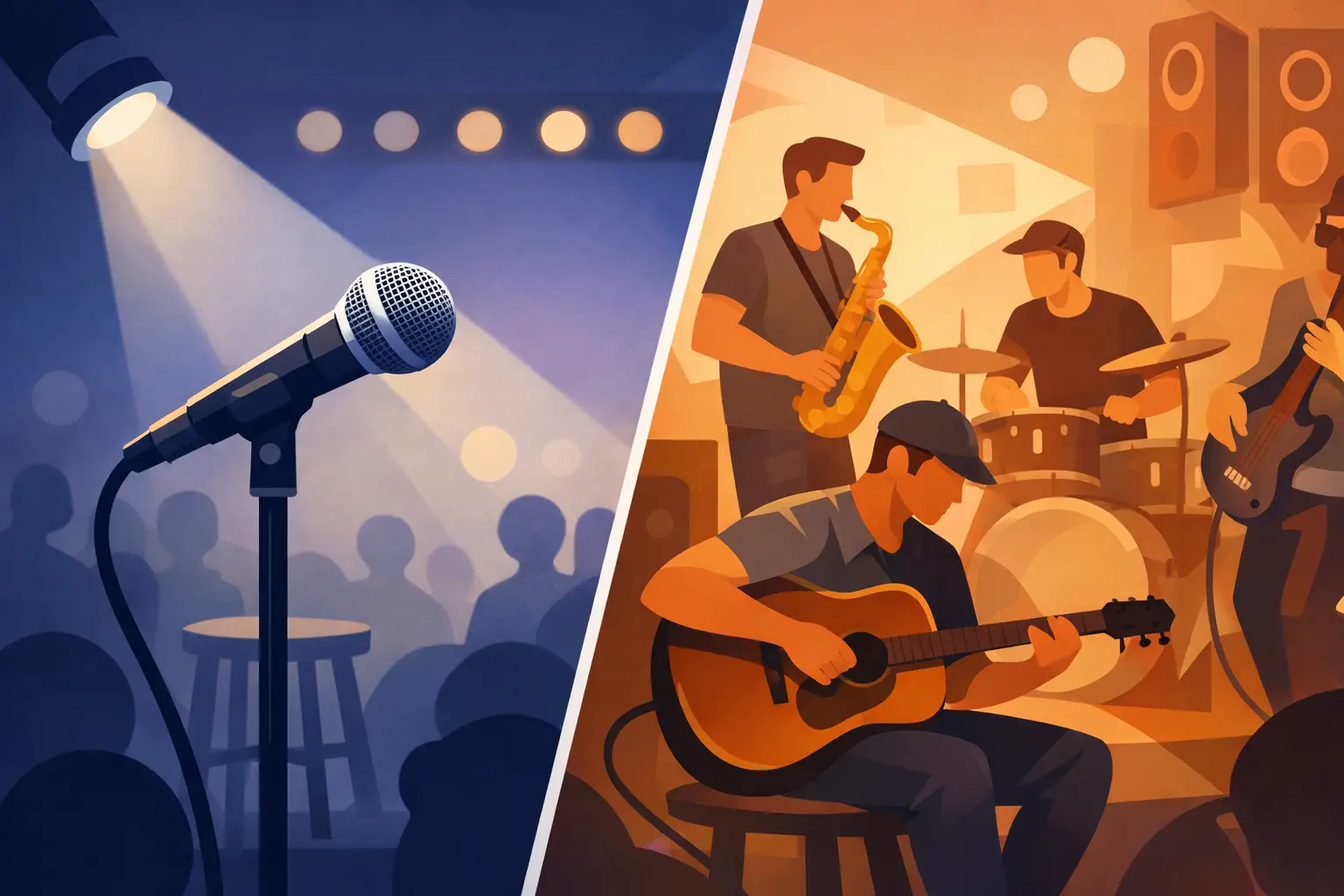
You turn up with your guitar, a couple of songs ready, and then realise half the room is trading solos over a groove that has no set list and no obvious ending. It happens all the time. The difference between open mic and jam session sounds simple until you're actually choosing where to go, what to prepare, and how you want to be seen in your local scene.
If you're building momentum as a musician, this choice matters more than it seems. Open mics and jam sessions can both lead to contacts, confidence, and future gigs, but they reward different strengths. Knowing which room suits you can save you awkward first impressions and help you get more from every night out.
What is the difference between open mic and jam session?
At the simplest level, an open mic is usually a turn-based performance night where individuals or small acts sign up to play a short set. A jam session is more fluid and collaborative, with musicians joining in live around shared songs, grooves, keys, or progressions.
An open mic tends to centre the performer and their prepared material. A jam session tends to centre interaction between players in real time. That one distinction changes almost everything - the prep, the pressure, the etiquette, and the kind of opportunities that come from it.
How an open mic usually works
Most open mics run on a list. You arrive, put your name down, wait for your slot, then perform one to three songs or a short set. Sometimes there is a house PA and host. Sometimes there is a backline. Sometimes it's stripped back and very acoustic.
The main point is that your slot is yours. Even if the room is relaxed, there is usually a structure. You're being given a defined window to present yourself, your songs, your voice, or your act.
For singer-songwriters, solo artists, duos, poets, and acts testing original material, this can be ideal. You get a clear stage moment. People can hear your writing, your arrangement choices, your tone, and your stage presence without too much interruption.
That does not mean open mics are always formal. Some are noisy pub nights with loose hosting and plenty of chat at the bar. Others feel almost like showcases. The format can vary, but the core idea stays the same: you perform, the room listens, and then the next act goes up.
How a jam session usually works
A jam session is less about taking your individual slot and more about joining a moving musical conversation. There may be a host band or house rhythm section. There may be a loose songbook, a genre focus, or just an understood level of musical etiquette.
Instead of presenting a rehearsed mini-set, you step into an existing flow. You might be called up for one tune, a few choruses, or a whole section of the night. You may need to pick up cues quickly, follow key changes by ear, comp behind someone else, or leave space when the music needs it.
This is why jam sessions often attract players who are comfortable with improvisation, reading a room, and adapting on the fly. Jazz, blues, funk and soul scenes especially lean into this format, but you will find jam culture in plenty of genres.
A good jam is collaborative, not competitive. The best ones are about listening as much as playing.
Open mic vs jam session: the real differences that affect you
Preparation
For an open mic, preparation usually means rehearsing songs you already know well. You can think about intros, endings, lyrics, pacing, and how to make the most of a short slot.
For a jam session, preparation is broader. You may need a working knowledge of common standards, grooves, chord progressions, hand signals, and stage etiquette. You are preparing your musicianship rather than a fixed performance.
Pressure
Open mics can feel emotionally exposing because the spotlight is directly on you and your material. If you're singing your own songs, there is nowhere to hide.
Jam sessions can feel musically exposing because your instincts, timing, and listening skills are immediately visible to other players. You may feel less alone, but more scrutinised by musicians.
Neither is easier. It depends on what kind of pressure you handle best.
Audience expectations
At an open mic, the audience often expects variety. One act may play indie originals, the next a stripped-back cover, the next spoken word. The room is there to discover individuals.
At a jam session, the audience often expects chemistry, spontaneity, and strong interplay. They are watching the room create something live, not just deliver a prepared piece.
Networking value
Open mics are great for being remembered as a writer, vocalist, or solo performer. If you want promoters, hosts, and fellow artists to understand your identity quickly, they can be very effective.
Jam sessions are great for showing that you can work with others. If you want to be noticed as a reliable guitarist, drummer, bassist, keys player, horn player, or adaptable vocalist, jams often reveal that faster than a solo slot ever could.
That distinction matters if you're chasing session work, band invites, dep opportunities, or collaborations.
Which one is better for beginners?
It depends on what kind of beginner you are.
If you have a couple of songs, want stage time, and need to build confidence performing in front of a room, an open mic is often the easier entry point. You can prepare at home, keep things simple, and focus on getting through your set well.
If you are already comfortable with your instrument, can follow chords or common forms, and want to meet players quickly, a jam session may actually be the better move. You do not need to carry a whole room on your own, but you do need to listen closely and stay musically aware.
Many musicians start with open mics because the format is clearer. Many grow into jams because that is where local scenes often become more connected. One is not a lesser version of the other. They develop different muscles.
How to choose the right room for your goals
If your goal is to test original songs, build confidence on the mic, or present yourself as an artist with your own material, choose the open mic. If your goal is to meet players, prove your versatility, and get involved in a more collaborative part of the scene, choose the jam.
If you sing but do not accompany yourself, the answer can be mixed. Some open mics will suit you if there is supportive hosting and simple backing options. Some jam sessions will suit you if the room welcomes vocalists and has familiar material. It is worth checking the event format before you go.
Genre also matters. A folk open mic and a late-night funk jam are very different social spaces. The same musician might thrive in one and feel completely out of place in the other.
The smart move is to stop thinking about which format is better overall and start asking which format helps you move forward this month.
What good etiquette looks like in both spaces
Whatever room you choose, a few habits go a long way. Arrive on time. Respect the host. Keep your setup quick. Support other performers. Read the energy of the room.
At an open mic, do not run over your slot, spend five minutes tuning on stage, or treat the audience like they owe you silence if the venue is clearly casual. Be prepared and adaptable.
At a jam session, do not overplay, hijack every solo, call obscure tunes nobody else knows, or ignore cues from the host band. Good jamming is about awareness. Players remember the musicians who make the room feel better.
That last point is underrated. In local scenes, reputation is often built before anyone hears your best material. The way you participate matters.
Why both formats matter in a local music scene
Open mics help scenes stay porous. They create low-barrier entry points for new artists, songwriters, and performers who need somewhere to begin. Jam sessions help scenes stay connected. They create repeated interaction between musicians who might later form bands, book each other, or recommend each other for work.
That is why many active artists end up using both. One builds visibility around your own voice. The other builds trust around your ability to collaborate.
If you're trying to find the right events more consistently, having one place to track what is happening locally makes a real difference. Platforms like Groovehub are useful here because they help musicians discover open mics and jam sessions based on their city, while also making it easier to show who you are professionally when the right room leads to the right conversation.
The difference between open mic and jam session is really about intention
On paper, the format is the difference. In practice, intention is the bigger one. An open mic asks, what do you want to show? A jam session asks, how do you play with others?
Both questions matter if you are serious about growing in your scene. Pick the one that matches your next step, not your comfort zone. The right room at the right time can change everything.